
 |
 |
 |
| Superintendent | Senator (senior) | Senator (junior) |
| Foley Kiatamba | Simeon Boima Taylor | Dabah M. Varpilah |
All Districts Leadership in Grand Cape Mount
| County Profile Overview: Grand Cape Mount | |||||
|---|---|---|---|---|---|
| Year Established | Capital | Population (2022) | Area | Electoral Districts | Population Density |
| 1856 | Robersport | 178,867 | 5,160km² | 3 | 34.66 persons/km² |
Created in 1856, Grand Cape Mount County, located in Liberia, is a first-level administrative division with its capital being Robertsport.
Background and Introduction
Spanning 5,160 square kilometers (km²), Grand Cape Mount is one of Liberia’s 15 counties situated in the western region, in the south-eastern corner of Liberia and bordered in the Northeast by Gbarpolu County, in the East by Bomi and Lake Piso, in the South by the Atlantic Ocean and in the West by Sierra Leone.
There are 3 Electoral Districts (ED) 1, 2, and 3; and 6 Administrative Districts (Garwula, Golakonneh, Porkpa, Commonwealth Robertsport, Tewor, and Gounwolaila), comprising 1 Chiefdom and 29 Clans. County leadership is headed by a superintendent, while districts, townships, and boroughs are governed by representatives and senators, commissioners, and governors respectively.
| Administrative Structure Overview: Grand Cape Mount | ||
|---|---|---|
| Category | Count | Details |
| Electoral Districts | 3 | ED 1, ED 2, ED 3 |
| Administrative Districts | 6 | Garwula, Golakonneh, Porkpa, Commonwealth Robertsport, Tewor, Gounwolaila |
| Chiefdoms | 1 | County total |
| Clans | 29 | County total |
According to the 2022 census by the Liberia Institute of Statistics and Geo-Information Services (LISGIS), the population stands at 178,867 made up of 96,757 males and 82,110 females representing 54.1% and 45.9.% respectively. See the Table below.
| Administrative Districts Population Overview: Grand Cape Mount (County Total: 178,867) | ||||||
|---|---|---|---|---|---|---|
| Admin District | Male | Male % | Female | Female % | Total | % of County Population |
| Garwula | 17,072 | 51.1% | 16,331 | 48.9% | 33,403 | 18.7% |
| Golakonneh | 25,489 | 55.7% | 20,309 | 44.3% | 45,798 | 25.6% |
| Porkpa | 28,980 | 56.7% | 22,151 | 43.3% | 51,131 | 28.6% |
| Commonwealth Robertsport | 7,138 | 50.8% | 6,919 | 49.2% | 14,057 | 7.9% |
| Tewor | 18,078 | 52.4% | 16,400 | 47.6% | 34,478 | 19.3% |
| Gounwolaila | 9,513 | 52.9% | 8,473 | 47.1% | 17,986 | 10.1% |
| Total | 96,757 | 54.1% | 82,110 | 45.9% | 178,867 | 100.0% |
According to the 2022 census by the Liberia Institute of Statistics and Geo-Information Services (LISGIS), the population stands at 178,867 made up of 96,757 males and 82,110 females representing 54.1% and 45.9.% respectively and 3.41% of the national population figure of 5,250,187. See the Table below.
| County Population Overview: Grand Cape Mount | ||||||
|---|---|---|---|---|---|---|
| Population (2022) | Male | Percent | Female | Percent | National Percentage | National Total |
| 178,867 | 96,757 | 54.1% | 82,110 | 45.9% | 3.41% | 5,250,187 |
Religious harmony and intermarriage among the various ethnic groups has woven a rich social fabric, which made this to be known as one of the most peaceful counties in Liberia until the Civil War.
The five major ethnic groups in the County are the Vai, Gola, Mende, Mandingo and Kissi. Other minority ethnic groups include Bassa, Gbandi, Kpelleh, Grebo, Kru, Lorma, and Mano. The Vai vernacular is widely spoken, followed by the Gola, with percentage distributions of 60% and 23% respectively. Mende, Mandingo and Kissi languages are also spoken by sizeable minorities. The Vai script, introduced by Bokeleh, serves as means through which many locals are able to communicate and keep financial transactions and other records. Culturally, inter-marriages among the tribes are permissible and common. This leads to cultural assimilation that creates a bond of unity.
History
In 1461, Pedro De Sintra, a Portuguese Navigator on a mission to the West Coast of Africa, saw the beauty of the cape and mountains and named the area Cape du Mont, a Portuguese word meaning the Cape of the Mount, from which the name Grand Cape Mount County was derived. In 1822, Liberia was founded by the American Colonization Society as a result of freedom gained by the men and women of African decent in the USA.
During this period, Cape Palmas was an independent territory and was given the name of Maryland in Africa. In 1847, Liberia declared her status to the world as a free, sovereign and independent nation, becoming the Republic of Liberia. At the time there were only three counties: Montserrado, Grand Bassa and Sinoe. Being too small and isolated to be an independent nation in the scramble for Africa, the area now known as Grand Cape Mount annexed herself to the lone Black Republic becoming the Fourth County. By this time, Cape Mount was known as the territory of Grand Cape Mount under Montserrado County.
In 1856, Cape Mount was carved out of Montserrado by a legislative act and became the fifth oldest County of the Republic of Liberia, known as Grand Cape Mount County. The name is derived from the beautiful green mountains above and the beautiful green vegetation below on the Atlantic Ocean.
The natural beauty of the County headquarters of Robertsport is depicted by the existence of the Wakolor Mountain close to the shores of the Atlantic Ocean, which is watered by lagoons and Lake Piso and the mixed species of animals and plants that make the County one of the biodiversity hotspots and most attractive natural tourist area in Liberia.
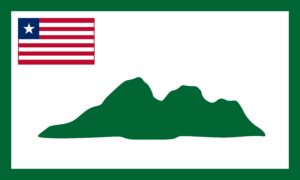
The County Flag shows a mountain against a white field in a rectangular shape, indicating peace and purity, with the Liberian flag on the top left corner. Religious harmony and intermarriage among the various ethnic groups has woven a rich social fabric, which made this to be known as one of the most peaceful counties in Liberia until the Civil War.
Flag
The flag of Grand Cape Mount represents peace and purity and the natural beauty of the county.
Technical Description
The flag incorporates a mountain against a white field in a rectangular shape. A small Liberian flag appears in the canton and the county emblem appears on the field.
Design Elements and Symbolism
White Background – Represents peace and purity of the local county people.
Green Mountains – Symbolize the hilly and natural beauty of its landscape.
Liberian Flag Canton – Unity with the Republic.
Climate
The climate of the County is humid and tropical with two distinct seasons: the wet season and the dry season. The wet season begins in April and ends in October with an average rainfall of 400 cm and temperatures ranging from 28 degrees and 34 degrees Celsius, while humidity goes as high as 90 to 100 percent. The dry season is from November to March. Cape Mount, being a coastal County, has high annual average rainfall because the coastline runs approximately from South-east to Northwest and at right angles to the prevailing south-western rain-bearing winds.
Topography
Grand Cape Mount County has a large natural lake called Lake Piso, which forms a confluence with the Atlantic Ocean with beautiful shores that attract tourists. The County is also endowed with mountains such as the Bie Mountains in Porkpa and Gola Konneh Districts, which contains a large deposit of iron ore. Cape Mount County is served with a good network of rivers such as Maffa, Mani, Konja, and Lofa, which separates Bomi from Cape Mount, and the Congo Mano River, separating Sierra Leone and Liberia. These rivers contain rich deposits of gold and diamonds and provide food and livelihoods for many communities.
Geology
The County is richly endowed with natural resources, mainly iron ore in Porkpa and Gola Konneh Districts, and diamonds and gold in Porkpa, Gola Konneh and Tewor District. It was reported during the CDA consultations that there may be valuable deposits of oil around Bobojah in Garwular District, though a geological survey has yet to confirm this claim.
Vegetation
Grand Cape Mount coastal belt is rich with coastal mangrove, farmland, coastal savannah and secondary forest. Tewor, Porkpa and Gola Konneh Districts are mostly covered with semi deciduous and rainforest. A portion of the Gola Forest runs through the County, with a variety of wildlife species such as elephants, monkeys, chimpanzees, pottos, genets, pigmy hippopotamus, zebra duiker, leopards, egrets and owls, among others.
Religion
The two main religions in the County are Islam and Christianity. It is estimated that 70% of the population in Cape Mount are Muslims, while 25 are Christians and a smaller minority are practitioners of traditional religions. The relationship between the two major religious communities is largely harmonious.
Credit Sources:
Republic of Liberia – Ministry of Internal Affairs
Liberian Government Gazette (1964 Establishment Act)
National Archives of Liberia
Grand Cape Mount County Administration
Official County Publications
County Development Agenda (CDA)
2022 Housing and Population Census: Liberia Institute of Statistics and Geo-Information Services (LISGIS)
National Elections Commission (NEC), Republic of Liberia
Senate.gov.lr

Grand Cape Mount District 1
Grand Cape Mount Electoral District 1 has a registered voter population of 26,631 made up of 15,601 males and 11,030 females as of July 2023. See the Table below. District Population Overview: Grand Cape Mount Electoral District 1 Population (2023) Male Percent Female Percent 26,631 15,601 58.58% 11,030 41.42%
Grand Cape Mount District 2
Grand Cape Mount Electoral District 2 has a registered voter population of 28,451 made up of 14,652 males and 13,799 females as of July 2023. See the Table below. District Population Overview: Grand Cape Mount Electoral District 2 Population (2023) Male Percent Female Percent 28,451 14,652 51.50% 13,799 48.50%
Grand Cape Mount District 3
Grand Cape Mount Electoral District 3 has a registered voter population of 31,447 made up of 15,800 males and 15,647 females as of July 2023. See the Table below. District Population Overview: Grand Cape Mount Electoral District 3 Population (2023) Male Percent Female Percent 31,447 15,800 50.24% 15,647 49.76%
Grand Cape Mount Districts (Administrative)
Grand Cape Mount County has 6 Administrative (Garwula, Golakonneh, Porkpa, Commonwealth Robertsport, Tewor, and Gounwolaila), with a population of 178,867.